

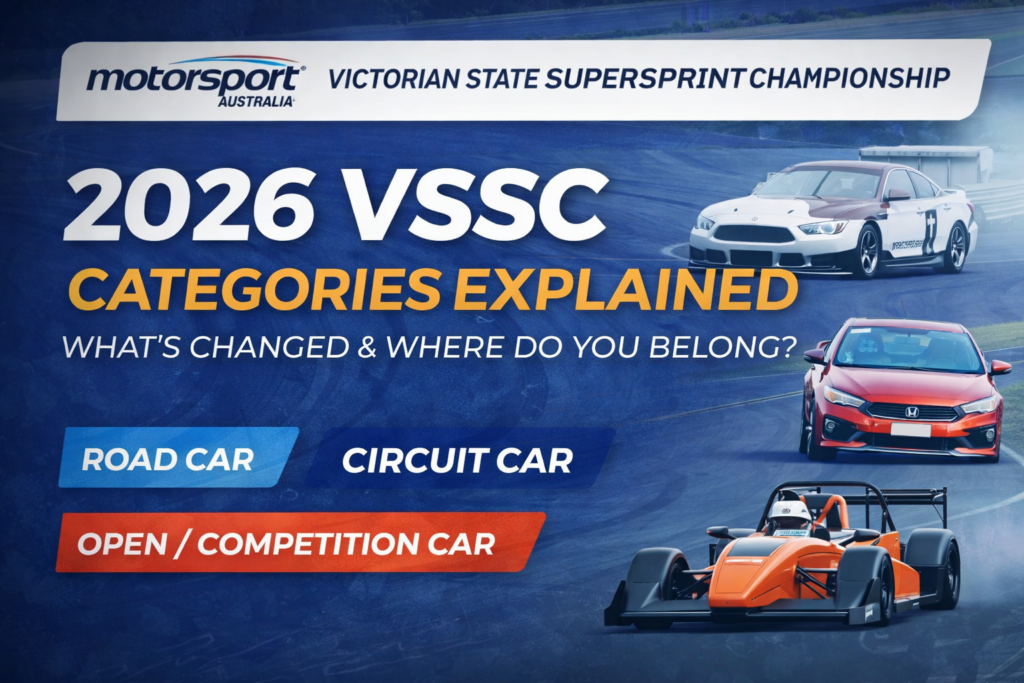
2026 VSSC Categories Explained – What’s Changed and Why
As we prepare for the 2026 Victorian State SuperSprint Championship, the VSSC Panel has reviewed and refined the vehicle category structure to make it clearer, fairer, and easier to understand for competitors and clubs alike.
The aim is simple:
Put similar cars together, reduce confusion, and make it obvious where your car belongs.
Below is an overview of the 2026 categories and how they work.
Why the categories were updated
Over recent seasons, we’ve seen:
-
- Cars sitting on the borderline between classes
-
- Confusion around logbooks, tyres, and eligibility
-
- Road cars, circuit cars and race cars overlapping more than intended
For 2026, categories have been clearly separated by intent rather than by modification level.
2026 VSSC Vehicle Categories – At a Glance
Road Car (RC)
For: Genuine road-registered cars.
-
- Must be road registered (or on a club permit)
-
- Road-legal tyres only
-
- Front interior retained
(rear seat may be removed where required for an approved cage)
- Front interior retained
-
- OEM-style ECU
-
- Designed for street-based cars that also enjoy the track
Ideal for newcomers and lightly modified cars.
Circuit Car (CC)
For: Log-booked, production-based circuit cars, including road-registered vehicles that do not comply with Road Car regulations.
-
- Must hold a Motorsport Australia Log Book, or be a road-registered vehicle modified beyond Road Car limits
-
- Slick tyres not permitted
-
- Treaded / semi-slick tyres only
-
- Prepared beyond Road Car limits
This category captures cars that sit between Road Car and Open, including road-registered vehicles with modifications (e.g. suspension, electronics, or tyres) that exceed Road Car allowances.
Open / Competition (OC)
For: Highly modified or purpose-built competition cars.
-
- Slick tyres permitted
-
- Includes Clubman, sports racers, prototypes and Time Attack–style builds
-
- High-performance vehicles built purely for competition
-
- Typically log-booked due to speed and safety requirements
If your car is on slicks or no longer resembles a production car in intent or performance, it belongs here.
Historic / Classic (HC)
For: Motorsport Australia Historic (Category 5) vehicles.
-
- Must hold a Historic Log Book
-
- Prepared to recognise period specifications
-
- Includes Historic Touring and Sports Cars
-
- Authenticity and period correctness are key
This category exists to preserve motorsport heritage, not to house modernised builds.
Non-Logbooked (NL)
For: Cars that are neither road registered nor log-booked.
-
- Accepted at the discretion of the Organiser or VSSC Panel
-
- Must still comply with safety requirements and pass scrutiny
-
- Eligible for Class awards only
-
- Not eligible for Outright or Overall awards
This category provides a safe entry point for new builds and transitional cars, while encouraging competitors to move toward full compliance.
Engine capacity classes
Within each category, cars are further divided into engine-capacity classes to ensure fair competition with similar machinery.
Effective capacity is calculated in accordance with NCR 13, including multipliers for turbocharged, rotary, diesel and hybrid vehicles.
What this means for competitors
-
- Clearer category placement
-
- Less ambiguity at scrutineering
-
- Consistent application across clubs and rounds
-
- Fairer competition at all levels
If you’re unsure where your car fits, ask early — the Panel is happy to assist before entries open.
Want the full detail?
This article is intended as a plain-English guide.
The full technical requirements are set out in the 2026 VSSC Technical Regulations, which can be found here:
[Link to 2026 VSSC Technical Regulations]
More details can be found here https://www.vssc.com.au/categories-classes/